
本页内容
IoT teams know the drill. You connect thousands of devices to an MQTT broker, telemetry starts flowing, and then the real work begins: picking a database, building ingestion pipelines, wiring up middleware, and keeping it all running. With the Greptime and EMQ partnership, that entire middle layer disappears. GreptimeDB now powers EMQX Tables—a fully managed time-series database built directly into EMQX Cloud—so your data goes from device to dashboard on a single platform.
Why This Partnership Matters
EMQ operates EMQX Cloud, one of the world's most widely deployed MQTT platforms, with over 250 million connected devices across 60+ countries. Greptime builds GreptimeDB, an open-source, cloud-native time-series database designed for high-throughput IoT and observability workloads.
Each company solves a different half of the IoT data problem. EMQX handles connectivity: million-device MQTT access, message routing, and protocol conversion. GreptimeDB handles storage and analytics: high-throughput ingestion, real-time queries, and cost-effective long-term retention.
EMQX Tables brings these capabilities together as a native service inside EMQX Cloud. No external database to provision. No integration middleware to maintain. No data pipeline to babysit.
What Is EMQX Tables?
EMQX Tables is a time-series database service embedded in the EMQX Cloud platform. Powered by GreptimeDB, it stores, queries, and analyzes MQTT data without leaving the EMQX environment.
Here's how it works:
- Connect your devices to EMQX Broker via MQTT.
- Route telemetry from MQTT topics to EMQX Tables using the built-in rule engine—no custom code, no ETL.
- Query your data with standard SQL or PromQL from the EMQX Cloud console.
- Visualize with Grafana, Metabase, or any SQL-compatible tool.
The entire path from device message to dashboard runs on one managed platform.
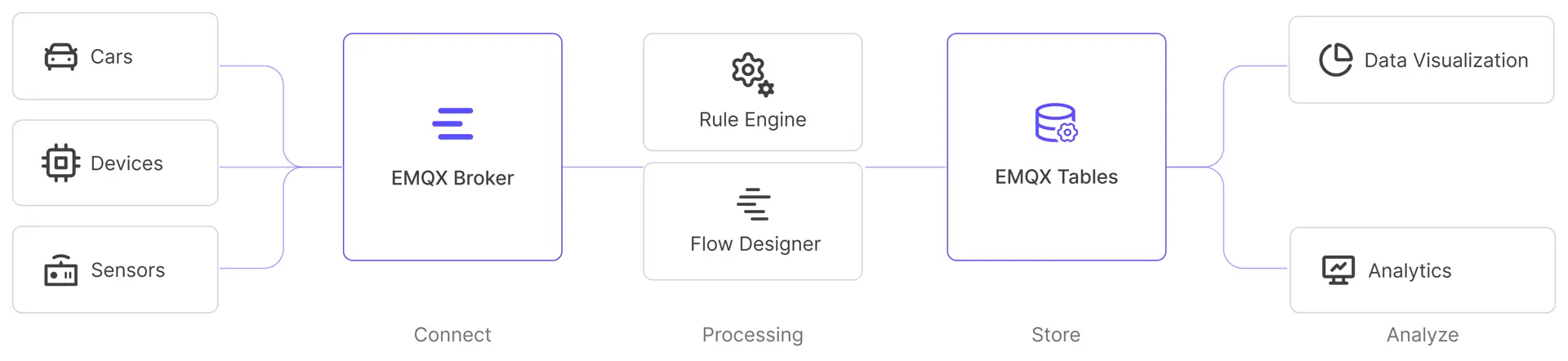 Image source: EMQX Tables GA: From MQTT Data Stream to Time-Series Insight in One Platform
Why GreptimeDB?
Among all the time-series databases available, EMQ chose GreptimeDB to power EMQX Tables (see Why EMQX Tables Chose GreptimeDB for the full story). A few architectural decisions made the difference:
Object storage-first design. GreptimeDB uses object storage (S3, GCS, MinIO) as its primary storage layer—not as an afterthought. For IoT workloads generating terabytes of telemetry daily, this can reduce storage costs by 3–20x compared to databases that depend on local SSDs or block storage. A multi-tier caching system keeps query performance fast despite the underlying object storage.
Schemaless ingestion. IoT environments are messy. Device types change, new sensors appear, payload formats evolve. GreptimeDB creates tables and columns automatically on write, so there's no need to predefine schemas or run migrations every time a new device type shows up.
Broad protocol support. GreptimeDB natively supports InfluxDB Line Protocol, Prometheus Remote Write, and OpenTelemetry (OTLP). Teams already running Telegraf, Prometheus, or OpenTelemetry collectors can integrate GreptimeDB with minimal changes to existing pipelines.
Open-source distributed architecture. GreptimeDB's full distributed architecture—Frontend, Datanode, and Metasrv—ships under Apache 2.0. Whether you self-host or use EMQX Tables, the underlying engine is identical.
Use Cases
The combined platform serves a broad range of IoT scenarios:
- Industrial IoT — Monitor production lines, store sensor data for predictive maintenance, and run equipment analytics, all without managing separate database infrastructure.
- Connected Vehicles — Collect vehicle telemetry at scale (speed, diagnostics, battery health) with cost-effective retention for fleet-wide trend analysis.
- Smart Energy — Track grid stability, renewable output, and consumption patterns across distributed assets, with SQL-based alerting and Grafana dashboards.
- Smart Cities — Store and query environmental sensors, traffic data, and infrastructure health metrics in one place.
Getting Started
EMQX Tables is generally available for all EMQX Cloud users. You can create an EMQX Tables deployment from the console in minutes.
- Start a free trial: Log in to EMQX Cloud console to start your deployment.
- Read the Docs: Check out the Overview and Quick Start Guide to hit the ground running.
To explore GreptimeDB directly:
- Open source: github.com/GreptimeTeam/greptimedb
- Documentation: docs.greptime.com
For a deeper look at how GreptimeDB powers EMQX Tables, watch the joint webinar: Introducing EMQX Tables: From MQTT Data to Time-Series Insights, featuring Ning Sun (CTO, Greptime) and Benniu Ji (VP of Products, EMQ), along with a customer case study from TVU Networks.
Connecting devices is only half the battle. Making sense of the data they produce is where the real value lies. With EMQX handling connectivity and GreptimeDB handling storage and analytics, IoT teams can stop managing infrastructure and start building applications.


